NEXT-GENERATION ARCHITECTURE
From data signals to clinical solutions, not alerts.
Ardia's AI-first architecture transforms clinical data into actionable insights using healthcare-tuned foundation models, reasoning engines, and supervised reinforcement learning — delivering solutions that solve problems, not just warn about them.
INTELLIGENCE PIPELINE
Data transforms into clinical solutions.
A three-layer architecture that ingests, understands, and acts on clinical data at scale.
THREE-PART CARE INTELLIGENCE FLOW
Data sources connect in.
EHR / EMR, imaging systems, labs, claims, wearables and patient apps stream data into Ardia through secure connectors.
The Ardia Intelligence Core transforms it.
Ingestion, normalization, encryption and healthcare-tuned AI engines (LLMs, vision models, signal AI) convert raw signals into risk scores, predictions and recommendations.
Care experiences & quantum deliver impact.
Clinical AI, diagnostics copilots, RPM dashboards, precision health programs and device cloud analytics surface intelligence today — while future quantum workloads plug into the same core.
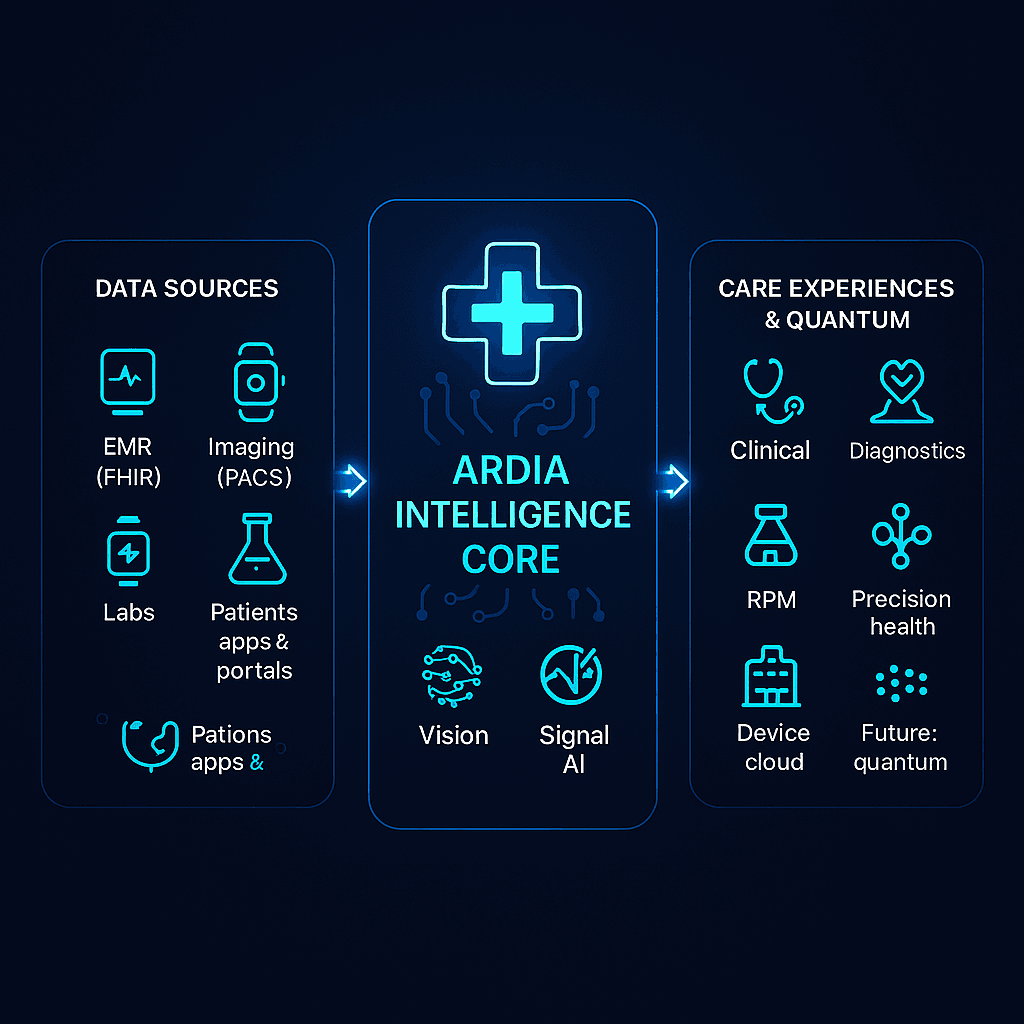
A visual view of how Ardia connects data sources, the intelligence core and care experiences.
HIGH-LEVEL FLOW
From raw signals to agents and experiences.
Data flows from EHRs, devices and documents into Ardia’s secure platform, where foundation models and agents operate over an MCP tool layer. SRL continuously improves behaviour from real-world feedback, while experiences stay simple for clinicians and patients.
1Data sources
Where clinical signals originate.
- • EHR / EMR (FHIR, HL7: encounters, meds, notes)
- • Imaging & labs (DICOM, LIS/HL7)
- • RPM & wearables (REST / streaming APIs)
- • Documents: visit summaries, letters, forms
- • Patient-reported outcomes & questionnaires
- • Payer rules, benefits and prior auth criteria
2Ardia intelligence fabric
Secure data platform
- • Encrypted PHI store (S3/Blob) for raw docs, audio and transcripts.
- • Relational DB (Postgres) for structured clinical entities.
- • Vector store (pgvector / Pinecone / Weaviate) for notes, guidelines and pathways.
- • Audit/event log for every agent action and tool call.
Models, tools & MCP layer
- • Foundation LLMs: GPT-4.1 / GPT-4o plus Ardia-tuned Llama / Mistral.
- • Specialised models: Whisper, OCR and optional imaging models.
- • MCP tools: FHIR read/write, knowledge retrieval, calculators, document generator, scheduling, billing rules.
- • Agents (documentation, prior-auth, patient explainer) call MCP tools instead of hard-coded APIs.
🧠 Clinical Intelligence / Reasoning Engine
- • Multi-signal correlation: Combines wearables, EHR, environmental APIs, voice biomarkers into unified patient context.
- • Cause determination matrix: Identifies why symptoms occur (pollen? medication gap? infection?) — not just that they occur.
- • Solution generation: Delivers specific interventions with clinical reasoning — "Use nasal steroid + avoid outdoors" not "SpO2 low alert".
- • 16+ chronic conditions: UAD, Asthma, COPD, CHF, AFib, Diabetes, CKD, Depression, and more with condition-specific reasoning.
Supervised reinforcement learning (SRL)
- • Capture de-identified transcripts, tool traces, outputs and human edits.
- • Train reward models on accuracy, safety, edit distance and guideline compliance.
- • Fine-tune models and tool-selection policies to reduce clinician edits over time.
- • Governance layer monitors for drift, bias and policy violations.
Future-ready for more general models
Agents are model-agnostic. As more powerful “near-AGI” models arrive, Ardia can plug them into the same MCP tool layer without changing integrations or experiences.
3Experiences & integrations
Solutions, not alerts — where patients and providers feel the value.
- • Doctor Dashboard: Critical/Attention/Stable patients — no alert fatigue, just actionable summaries with reasoning.
- • Patient Intelligence: Voice check-ins analyze health biomarkers and deliver personalized solutions, not generic reminders.
- • Clinical AI in EHR: ambient notes, coding suggestions, prior auth drafts with clinical reasoning.
- • Emergency Protocol: Auto-911 dispatch with 6-12 month health summary — paramedics arrive informed.
- • API & MCP endpoints for partners and future quantum workloads.
MODELS
Foundation models for Ardia.
- • GPT-4.1 / GPT-4o for complex reasoning and drafting.
- • Llama / Mistral variants fine-tuned with Ardia SRL.
- • Whisper and speech models for ambient documentation in clinic and telehealth.
- • OCR & layout models for scanned forms and PDFs.
TOOLS & MCP
Tool-centric agent layer.
- • MCP server exposing FHIR, search, calculators, templates.
- • Agents choose tools via policies trained with SRL instead of hard-coded flows.
- • Web, mobile and EHR plugins act as MCP clients.
- • All tool calls logged for audit and improvements.
DATA & RESIDENCY
Built for global regulations.
- • Region-locked PHI storage and compute (US, EU, etc.).
- • Configurable routing to external vs in-house models.
- • De-identification pipelines for SRL training data and analytics.
- • Fine-grained permissions by organisation, group and role.
DEEP DIVE
Detailed Architecture Flows
Visualizing how data moves through our system and how agents execute tasks.
Agentic Workflow: From Request to Action
Data Pipeline: Ingestion to Insight
Raw streams from EHR (HL7/FHIR), Devices, and Documents.
De-identification, cleaning, and conversion to standard schema.
Embedding generation for semantic search and retrieval.
Low-latency access for Agents and Analytics dashboards.
CLOUD INFRASTRUCTURE
Leveraging Google Cloud Healthcare APIs & AI Services
Built on Google Cloud Platform for HIPAA compliance, scalability, and advanced AI capabilities.
Google Cloud Healthcare API
FHIR-compliant data management and interoperability
FHIR Store
- • Patient data: Demographics, conditions, medications, allergies
- • Observations: Vital signs, lab results, device readings
- • Encounters: Visits, procedures, diagnoses
- • Medications: Prescriptions, administrations, adherence tracking
- • Interoperability: Standard FHIR R4 format for EHR integration
Data Ingestion & Processing
- • HL7v2 to FHIR: Automatic conversion from legacy systems
- • DICOM Store: Medical imaging integration
- • De-identification: HIPAA-compliant data anonymization
- • Streaming: Real-time data ingestion from devices
- • Backup & Recovery: Automated backups and disaster recovery
Google Cloud AI Services
Advanced AI capabilities for clinical intelligence
Vertex AI
- • Foundation Models: PaLM, Gemini for clinical reasoning
- • Custom Models: Fine-tuned for healthcare use cases
- • AutoML: Pattern recognition in patient data
- • Model Monitoring: Performance tracking and drift detection
Speech-to-Text
- • Voice Analysis: Patient voice biomarker extraction
- • Clinical Dictation: Provider note transcription
- • Multi-language: Support for diverse patient populations
- • Medical Vocabulary: Healthcare-specific language models
Document AI
- • OCR: Extract text from medical documents
- • Form Parsing: Insurance forms, prior auths
- • Entity Extraction: Medications, diagnoses, dates
- • Structured Data: Convert unstructured notes to FHIR
Infrastructure Components
🔒 Security & Compliance
- • HIPAA-compliant infrastructure
- • End-to-end encryption (AES-256 at rest, TLS 1.3 in transit)
- • Identity & Access Management (IAM)
- • Audit logging for all data access
- • SOC 2 Type II compliance
📊 Data Storage
- • Cloud SQL (PostgreSQL) for structured data
- • Cloud Storage for documents, audio, images
- • BigQuery for analytics and reporting
- • Vertex AI Vector Search for semantic search
⚡ Compute & Processing
- • Cloud Run for serverless API endpoints
- • Cloud Functions for event-driven processing
- • Compute Engine for ML model inference
- • Auto-scaling based on demand
🌐 Integration & APIs
- • Healthcare API for FHIR operations
- • Pub/Sub for event streaming
- • Cloud Tasks for async processing
- • API Gateway for external integrations